
Event Leadership · Career Growth
The Leadership Cost of Being the Person Who Always Figures It Out
Why the strengths that make us successful can become the very things that prevent us from becoming better leaders.

There is a particular kind of exhaustion that comes from being the person everyone expects to have the answer. Not because you're overwhelmed by the work itself, but because you're carrying the responsibility of making sure everything works.
You're the person people call when something goes wrong. The person who can walk into a complicated situation, make sense of the chaos, and find a way forward. The person who knows which conversation needs to happen, which decision can't wait, and which problem is about to become much bigger if no one addresses it.
And if you've built your career being that person, there's a good chance you're proud of it. I certainly understand why.
For nearly twenty years, I've worked in environments where the ability to solve problems quickly wasn't simply appreciated. It was expected. Global conferences, executive experiences, complex event portfolios, and high-stakes moments where hundreds of decisions have to come together, often under extraordinary pressure.
You learn to anticipate problems before they happen. You become comfortable making decisions with incomplete information. You develop an instinct for knowing when to step in.
Eventually, something interesting happens. People stop asking whether you can figure something out. They simply assume you will.
For a long time, I considered that one of the greatest compliments a leader could receive. Today, I see it differently.
Somewhere between becoming the person everyone relies on and becoming the leader everyone needs, there's a transition that doesn't get nearly enough attention.
The very strengths that made you successful can become the habits that limit your leadership.
The Competence Trap
Early in our careers, competence creates opportunity. We become known for delivering results, solving problems others struggle with, taking ownership, and demonstrating that we can handle increasingly complex responsibilities. That reputation matters. It's often how we earn our next promotion, our next opportunity, or our first leadership role.
But competence can also create a trap.
The better you become at solving problems, the more problems find their way to you. And the more problems you solve, the more indispensable you become. At first, that feels like success, until you realize you've built an organization, a team, or even an identity around your ability to be needed.
I've seen this dynamic play out across organizations and leadership levels. A talented manager becomes the final decision-maker for everything because their judgment is trusted. A department head remains involved in every operational detail because they know exactly how the work should be done. A senior executive struggles to delegate because the quality of the outcome feels inseparable from their personal involvement.
None of these leaders lack capability. Quite the opposite. They're often among the most capable people in the organization. But their capability has quietly become a constraint.
The team can't move without them. Decisions wait for their approval. Their calendars fill with problems someone else could have solved. And the leader who once created momentum begins unintentionally slowing it down.
Being indispensable feels like leadership. Building something that doesn't depend on you is leadership.
Organizations absolutely need people who take ownership and solve difficult problems. Those qualities don't suddenly become less valuable when someone moves into leadership. What changes is where that capability needs to be applied.
Instead of personally solving every problem, leaders must build the judgment, confidence, and systems that allow other people to solve problems well.
The skill hasn't disappeared. Its purpose has evolved.
At Some Point, You Have to Stop Being the Solution
One of the most difficult transitions in leadership is moving from doing the work exceptionally well to creating the conditions for others to do exceptional work.
We talk about delegation as though it's primarily a time-management skill. I don't believe it is. I believe it's an identity shift.
When you've built your reputation on being capable, responsive, and reliable, stepping back can feel uncomfortable. You see a problem and immediately know how to solve it. You hear a conversation going in the wrong direction and want to redirect it. You watch someone approach a challenge differently than you would, and every instinct tells you to intervene.
Sometimes intervention is necessary. But sometimes the most valuable thing you can do is allow someone else to find the answer. Not because their answer will necessarily be better, but because their ability to develop judgment matters more than your ability to provide another solution.
A leader who answers every question may create an efficient team in the short term. A leader who teaches people how to think creates a stronger organization over time.
That requires patience, coaching, trust, and the willingness to let someone approach a problem differently. Occasionally, it also means allowing someone to make a mistake you could have prevented, provided the consequences are manageable.
That's not easy when you're accustomed to being accountable for the outcome. But leadership isn't simply about protecting today's results. It's about developing tomorrow's capability.
The question isn't whether you could do it better yourself. It's whether doing it yourself is the best thing for the organization.
Your Team Shouldn't Need Your Brain to Function
I've spent much of my career in environments where operational excellence matters enormously. When you're responsible for a major global experience, you can't simply hope everything comes together. You need systems, clear responsibilities, decision-making structures, contingency plans, and people who understand the purpose behind the work.
That's the part I believe leaders sometimes overlook.
We teach teams what needs to happen, but we don't always teach them why. We explain the process, but not always the judgment behind it. We give people tasks without necessarily giving them context. Then we're surprised when every complicated decision comes back to us.
But if someone doesn't understand the larger objective, how can we expect them to make a strategic decision independently?
If every meaningful decision requires your involvement, you don't necessarily have a people problem. You may have a clarity problem, a trust problem, or a system that rewards escalation rather than ownership.
The solution isn't always hiring more people. Sometimes it's creating clearer decision rights. Sometimes it's giving teams access to information they previously didn't have. Sometimes it's defining success so clearly that people can evaluate options without waiting for approval.
And sometimes it's simply asking a different question.
Instead of asking, "What do you need me to do?" try asking, "What do you recommend, and why?"
That small shift creates space for judgment. And judgment is what turns talented employees into future leaders.
High Standards Shouldn't Require Constant Control
I care deeply about quality. I always have. I believe details matter, thoughtful preparation matters, and the experiences we create should reflect the standards we set for ourselves and our organizations.
But having high standards and needing control are not the same thing.
High standards define the outcome, while control dictates the path. High standards create accountability, while control can create dependency.
When you're managing a small project, you can personally influence nearly every detail. When you're leading a global portfolio, a large organization, or multiple strategic initiatives, that approach becomes impossible. More importantly, it becomes counterproductive.
You cannot scale your personal attention indefinitely. You have to scale your expectations, your systems, and your team's ability to make decisions.
That doesn't mean lowering the bar. It means being clearer about where the bar actually is.
What is nonnegotiable? Where is there room for interpretation? Which decisions require executive involvement? And where are we confusing personal preference with genuine business requirements?
These questions matter because excellence should be a standard the organization can uphold, not a personality it depends on.
The same principle applies to availability. Somewhere along the way, responsiveness became a proxy for leadership. The fastest reply, the late-night message, the person who answers while on vacation.
But every hour spent resolving an issue someone else could own is an hour unavailable for strategic thinking, developing people, or anticipating what comes next.
Not every problem is a leadership problem. Not every decision is an executive decision. And not every opportunity to help is an opportunity where you should intervene.
Sometimes the most valuable contribution you can make is creating the space for someone else to lead.
From Answers to Architecture: Three Responsibilities of Executive Leadership
As I've grown in my career, I've become increasingly interested in the difference between leaders who consistently deliver results and leaders who build organizations capable of delivering results without their constant involvement.
Both can be successful, but only one creates lasting scale.
I think about this shift through three responsibilities.
1. Create Clarity Before Creating Activity
People make better decisions when they understand what matters. That means defining outcomes, priorities, constraints, and the reasoning behind important decisions.
Consider a team preparing for a major executive experience. If their instructions are simply to deliver a flawless event, they'll naturally focus on flawless execution. But if they understand that the business objective is to deepen relationships with a specific group of strategic customers, their decisions become more intentional.
The agenda changes. The conversations change. The follow-up changes. Even the way they evaluate trade-offs changes.
The team is no longer simply executing a plan. They're making decisions in service of a larger outcome.
2. Develop Judgment, Not Just Capability
Technical skills can be taught. Processes can be documented. Tools can be learned. Judgment develops through experience, reflection, and responsibility.
Leaders accelerate that development by inviting people into the thinking behind decisions.
Why did we choose this direction? What trade-offs did we consider? What risks are we willing to accept? What would cause us to change course?
Those conversations build more than execution skills. They build leaders.
One of the most valuable things a senior leader can share isn't the final answer. It's the thinking that produced it.
3. Design Systems That Outlast Your Involvement
A strong organization should not depend on one person's memory, relationships, or ability to solve every problem. It needs repeatable systems, clear ownership, shared knowledge, feedback loops, and a culture where people feel empowered to make thoughtful decisions.
This connects directly to the philosophy behind my S.A.S. Framework™: Strategy, Alignment, and Scale.
Strategy establishes what matters. Alignment ensures people understand and own the direction. Scale makes excellence repeatable without requiring the same person to carry it every time.
The framework isn't about removing people from the equation. It's about building environments where more people can contribute at their highest level.
And that, to me, is one of the defining responsibilities of an experience executive.
From Exceptional Execution to Executive Leadership
There's a reason I believe this conversation matters particularly for professionals who have built their careers in events, experiences, marketing, and other execution-intensive disciplines.
Our industries reward the ability to deliver. We celebrate the person who can manage complexity, handle the unexpected, and keep everything moving when the pressure is on.
But there's a difference between being exceptional at execution and being exceptional at leadership.
Execution asks, "Can I deliver this successfully?" Leadership asks, "How do I create an organization that can deliver successfully?"
Execution focuses on the immediate outcome. Leadership considers the capabilities required to achieve that outcome repeatedly.
Execution often depends on individual expertise. Leadership turns expertise into shared organizational strength.
The strongest executives understand both. They know what excellent execution requires because they've experienced the complexity firsthand. But they also recognize that their greatest contribution is no longer managing every detail.
It's setting direction, aligning people, developing talent, and creating the conditions for sustainable performance.
This is the evolution I explore through The Experience Executive.
Not simply becoming more senior or managing larger budgets and more complex programs, but changing how you think about your role, your influence, and the value you create.
Because becoming an executive isn't only a change in title.
It's a change in responsibility, from delivering outcomes yourself to building the people and systems that make those outcomes possible.
The Thirty-Day Leadership Test
There's a question I've come to appreciate more as my career has evolved.
If I stepped away for thirty days, what would stop working?
It's not a comfortable question, especially if you take pride in being reliable. But it's revealing.
Would decisions stall? Would priorities become unclear? Would relationships suffer? Would the team struggle to navigate unexpected problems?
Or would the organization continue moving because people understand the direction, trust their judgment, and know how to work together?
The goal isn't to become irrelevant. It's to create value that extends beyond your personal involvement.
A leader's influence shouldn't be measured only by what happens when they're in the room. It should also be measured by what continues to happen when they're not.
It connects to something I believe deeply enough to make it part of the philosophy behind Sara Ann Straw Advisory:
Leadership isn't built by having all the answers. It's built by staying curious.
Curious about how people think, what they need to succeed, and whether our way of doing something is necessarily the only way.
The longer I lead, the more I appreciate the value of asking better questions. Not because answers don't matter, but because the right questions help other people discover what they're capable of.
One Final Thought
For much of my career, being the person who could figure things out was a source of pride. And in many ways, it still is.
I value resourcefulness, accountability, and people who step forward when something needs to get done. But I no longer believe the highest expression of leadership is being the person everyone depends on.
I believe it's creating an environment where people become more capable, more confident, and more empowered because of your leadership. Where your standards are understood, your judgment is shared, your team grows, and your impact becomes larger than the work you can personally accomplish.
That transition isn't always comfortable. It requires trust, patience, humility, and the willingness to redefine what success looks like.
But it's also where leadership becomes something much more meaningful than personal achievement.
Because eventually, the question is no longer whether you can figure everything out.
It's whether you've helped enough other people believe they can, too.
For more perspectives on leading teams, influencing executives, and building strategic experiences, explore Event Leadership Insights.
Key Takeaways
- Being indispensable isn't always a sign of effective leadership. It can also reveal organizational dependency.
- Delegation is more than distributing tasks. It's developing judgment, ownership, and confidence.
- High standards and personal control are not the same thing. Sustainable excellence requires clear expectations and empowered teams.
- Leadership effectiveness should be measured by the capability you build, not just the problems you solve.
- Strategy, alignment, and scale create lasting organizational strength. Teams perform better when they understand the direction, own decisions, and have systems that support them.
Questions for Reflection
- Where has my personal involvement become a bottleneck?
- Am I developing people who can make decisions, or people who wait for mine?
- If I stepped away for thirty days, what would continue working, and what would that reveal about my leadership?
Continue Your Leadership Journey
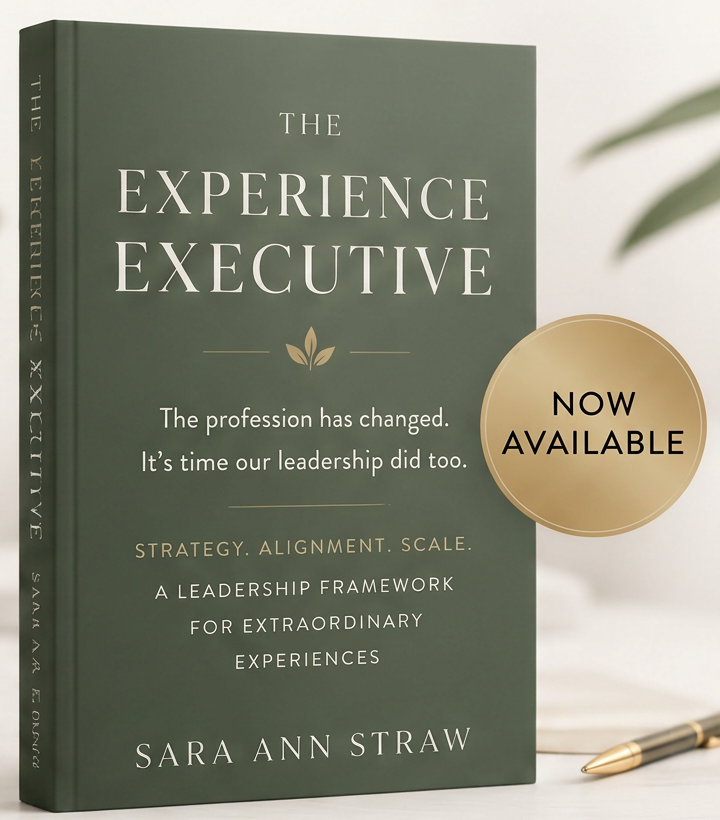
The Experience Executive
By Sara Ann Straw
Exceptional execution can build your career. Strategic leadership is what expands your impact.
There comes a point in every leadership journey when being great at what you do is no longer enough. The next chapter requires a different way of thinking about your role, the decisions you make, the people you develop, and the impact you want to create.
The Experience Executive builds on that conversation, exploring what it means to move beyond execution and grow into a leader who shapes strategy, influences decisions, and creates lasting organizational value.
If this article made you reconsider what leadership looks like at the next stage of your career, I invite you to continue the journey.
Sara Ann Straw is an event and experience leadership executive, advisor, and author with nearly two decades of experience leading global event portfolios, flagship conferences, executive experiences, and strategic marketing programs. Through Sara Ann Straw Advisory, she shares insights on event leadership, career growth, business strategy, organizational alignment, and the future of experiences.
Continue Reading
More from Career Growth.
Honest reflections on the strategy, people, and decisions behind extraordinary events.